The DSEX closed at 5,655.7 after falling 130.4 points, or 2.25%, during the week. The close was almost exactly at the 0.786 Fibonacci level near 5,654.7, allowing the index to rebound but not yet confirming a new uptrend.
Macroeconomic Factors
The latest T-bill auction was positive for equities. The 91-day rate declined to 8.8290% from 9.03%, the 182-day rate fell to 8.9200% from 9.14%, and the 364-day rate declined to 9.0700% from 9.17%. Average rates were 8.8272%, 8.8850%, and 9.0155%, respectively. Pro rata allotments were approximately 30%, 43%, and 63%, indicating strong demand relative to the available allotment.
Long-term bond yields declined more sharply. The 20-year T-bond rate fell to 9.1275% from 10.4000%, with an average rate of 9.1089% and approximately 28% client allotment. The 15-year rate declined to 9.0975% from 10.3425%, with an average rate of 9.0872% and approximately 35% client allotment.
Lower short-term and long-term yields can support equity valuations by reducing the return available from risk-free investments. But the reported government securities maturity pressure and rising borrowing requirements could create liquidity pressure later. The bond-market signal is positive, but it is not yet a guarantee of sustained equity-market liquidity.
External Factors
The US-Iran situation has moved beyond a purely military concern and now includes economic pressure and possible diplomatic activity. The visits by senior officials from Pakistan and Qatar, along with the reported Iran-Oman communication channel, could create a path toward negotiation.
This is not yet a confirmed settlement. But any meaningful de-escalation could reduce pressure on crude oil, LNG, shipping costs, and Bangladesh’s import bill.
Brent crude has declined to approximately $89.30 from the previous closing level of $94.39, a fall of about 5.4%. If this decline continues, it could reduce pressure on inflation, power generation, transport, and industrial costs. The benefit will remain limited unless lower global energy prices translate into better domestic energy supply.
Domestic Factors
LNG and gas supply appears to have improved compared with previous weeks, but the energy crisis remains unresolved. The comments that electricity problems may require two years to stabilize are negative for investment confidence and suggest that production interruptions and higher operating costs may continue.
The first two working sessions around the month-end closing period may also create selling pressure through margin adjustments, portfolio rebalancing, and cash requirements. This could push the index back toward its immediate support zone even if the broader market trend remains unchanged.
Regulatory Factor
The reported Tk 60,000 crore package for reopening closed or distressed factories could become a medium-term economic catalyst. Commercial banks are expected to provide Tk 41,000 crore, while the Bangladesh Bank would provide Tk 19,000 crore.
The initiative could support industrial production, employment, bank lending, and corporate earnings if the funds are used transparently and productively. However, weak borrower selection, political allocation, or poor monitoring could increase banking-sector risk. Investors should wait for evidence of actual disbursement, factory reopening, improved production, and repayment discipline.
Technical Outlook
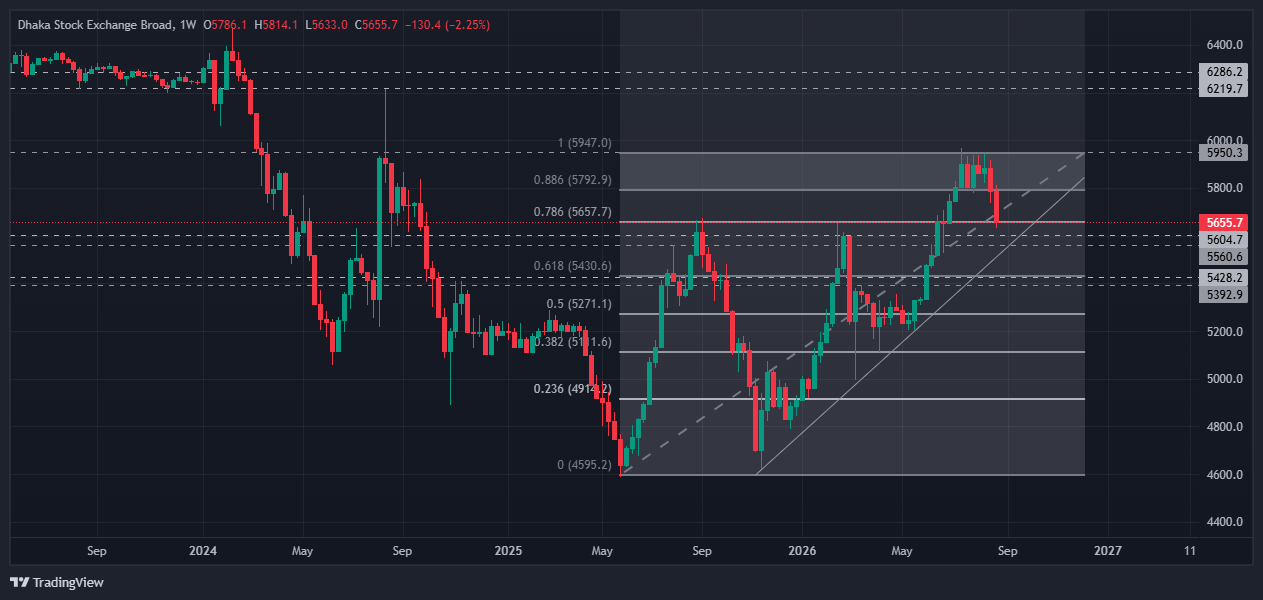
The first support zone is 5,620 to 5,640. The stronger channel support is 5,555 to 5,520. A hold above the first zone could lead to a rebound toward 5,696 to 5,720, followed by 5,786 to 5,828.
A sustained move above 5,786 to 5,828 with stronger volume would confirm that the rebound is becoming more reliable. A weekly close below 5,520 would invalidate the current recovery attempt and open the way toward the 5,396 to 5,430 Fibonacci support zone.
Investor Strategy at Key Levels
The DSEX is testing important support, not confirming a breakout. Lower bond yields, falling Brent crude, possible diplomatic progress, and the factory-reopening package are positive factors. The unresolved electricity crisis, borrowing pressure, geopolitical uncertainty, and month-end selling risk remain the main obstacles.
DSE investors should avoid aggressive buying and excessive leverage at the current level. Holding fundamentally strong companies and accumulating gradually near confirmed support is preferable. Fresh exposure should increase only after the DSEX reclaims 5,696 to 5,720 and then breaks above 5,786 to 5,828.









0 Comments