

The DSEX Return in October: What Investors Should Know as Declaration Season Begins
October brings a familiar question to Bangladesh’s stock market: will corporate declarations reward investors’ expectations, or force them to rethink the prices they have paid?
The historical record makes that question harder to ignore.
In the supplied dataset, the DSEX finished October below its opening level in every year from 2015 to 2025—eleven consecutive negative Octobers.
The consistency is striking, but the size of the declines tells a more useful story.
Calculated from the supplied opening and closing levels, October’s average change was −3.57%, with a median of −3.16%.
The weakest observation was 2024, at −7.56%, while 2023 was almost flat at −0.09%. October 2025 fell by −5.42%.
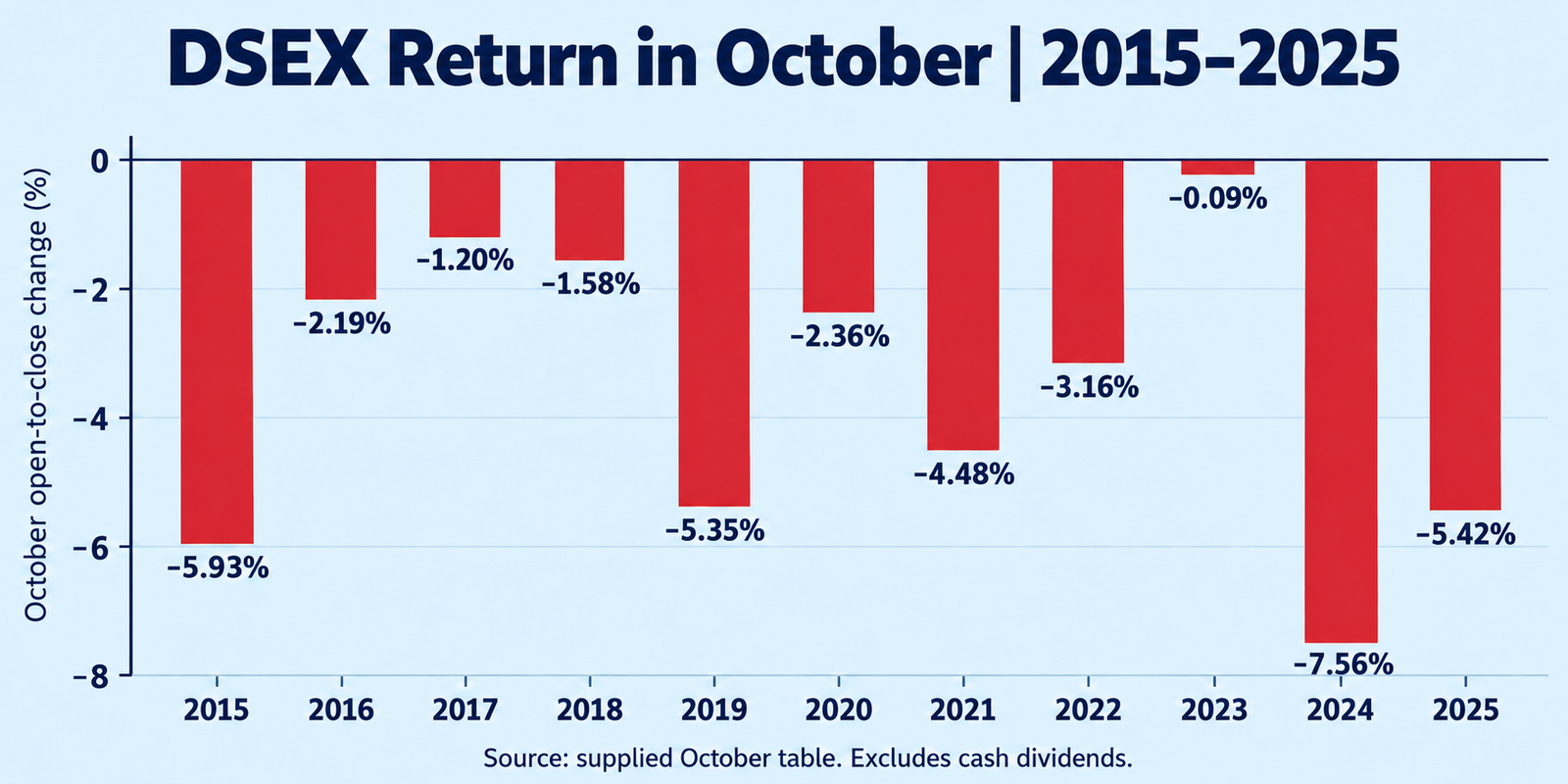
These figures describe eleven separate Octobers, not eleven years of continuously negative annual returns.
The earlier years tell a different story!
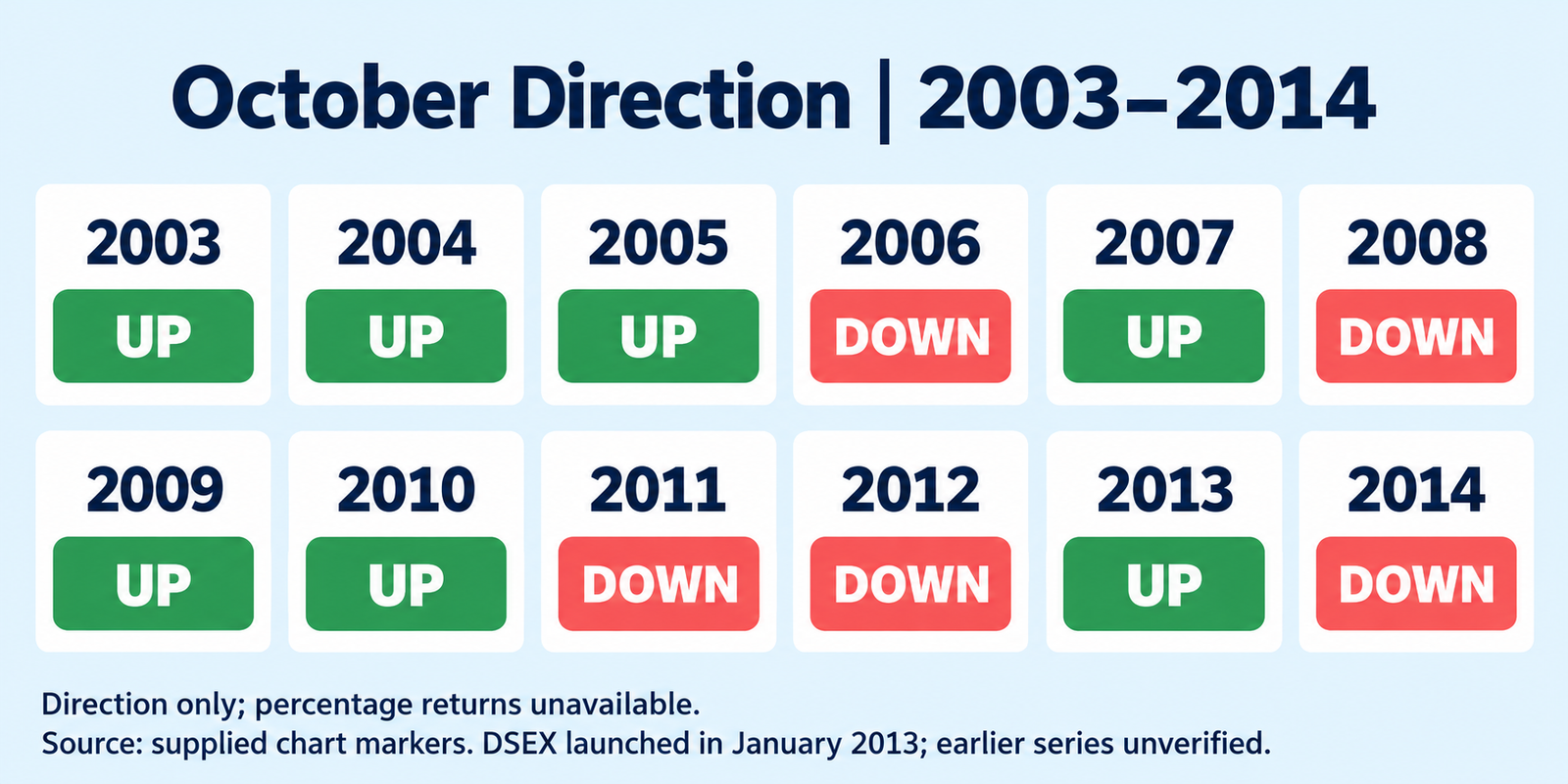
The supplied long-term chart suggests a more mixed October pattern during 2003–2014, with both positive and negative months.
Its coloured October markers indicate seven positive and five negative observations.
Why October Concentrates Investors’ Attention
The reporting-season explanation has a regulatory basis.
Under the BSEC-approved DSE Listing Regulations, 2015, Regulation 18(1) allows 120 days after year-end for annual auditing, followed by submission within fourteen days.
For a 30 June year-end, the audit window ends in late October.
Regulation 19 links adoption of annual accounts with a dividend recommendation—or a decision against one—and disclosure of EPS, NAV and operating cash flow per share.
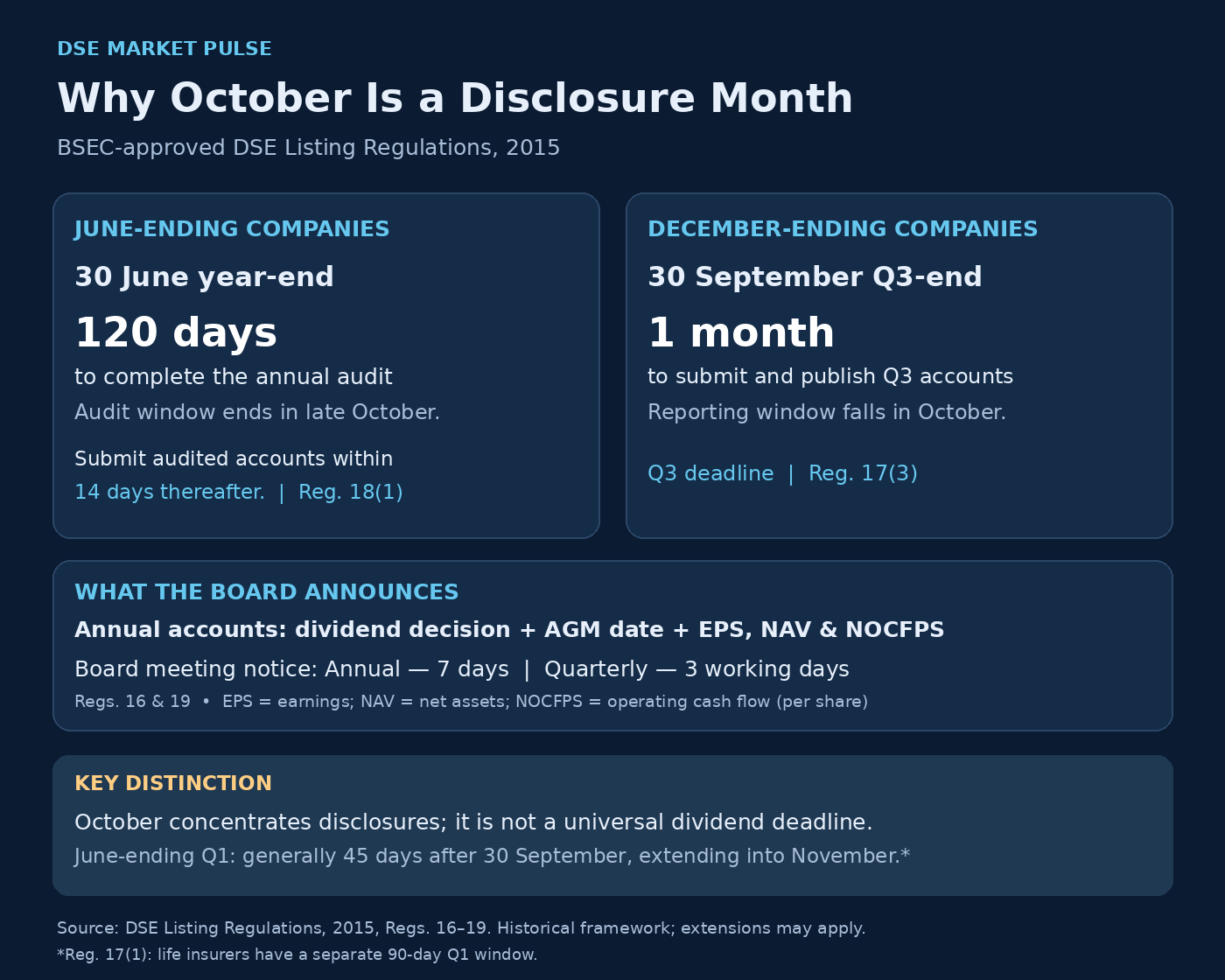
For December-ending companies, Regulation 17(3) requires Q3 statements within one month of 30 September, placing reporting in October.
Quarterly meetings require three working days’ advance notice under Regulation 16; annual adoption meetings require seven days under Regulation 19.
These deadlines explain October’s disclosure concentration; they do not require every company to declare a dividend specifically in October.
June-ending companies’ September-quarter Q1 reports generally have a 45-day window that extends into November.
When Expectations Meet the Numbers
A likely reason is that company results fall short of investors’ expectations.
Investors may buy ahead of results, anticipating stronger earnings or a generous dividend.
When the declaration falls short, the share price can adjust even if the business remains profitable.
A dividend can look attractive in isolation yet disappoint investors who expected more.
Weaker cash flow or an unfavourable earnings outlook can also outweigh the headline payout.
Even a good announcement can invite profit-taking if expectations were already reflected in the price.
Meanwhile, investors waiting for results may delay new purchases.
In a market with limited buying depth, that combination can increase selling pressure.
This is an interpretation of how reporting season can affect prices, rather than a finding that corporate declarations caused every October decline.
The distinction matters. The annual reporting calendar existed before the eleven-year streak, and the supplied earlier chart contains positive Octobers.
To establish a main cause, we would need company-level earnings surprises, dividend changes, announcement-day price reactions, and index contributions for each year, alongside liquidity and broader market conditions.
The return series alone cannot isolate those effects
What the Pattern Means for Investors
Eleven negative Octobers deserve attention, but they do not make the next October’s outcome certain.
The practical lesson is to examine how much optimism is already priced into a company before its declaration.
Earnings quality, operating cash flow, dividend sustainability and valuation provide a firmer basis for a decision than an anticipated payout alone.
October is best understood as a month when expectations face a public test.
Its recent history encourages discipline around corporate announcements, while leaving room for businesses whose results justify their valuations.
The calendar can identify a period to watch; the company’s numbers must still determine the investment case.



Leave a comment
Please login to leave a comment or reply.