

DSEX Weekly Update: November Opens With Support Under Pressure
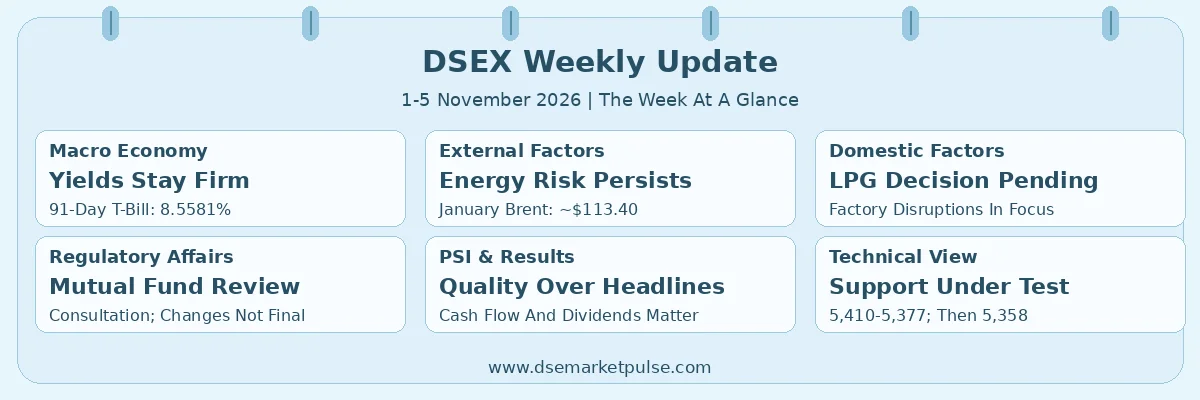
The DSEX closed the week at 5,417.44, losing 33.19 points, or 0.61%, from the previous close of 5,450.63. Average daily turnover improved 13.88% to Tk450.08 crore, while total turnover reached Tk2,250.38 crore. Yet the higher activity did not secure a sustained recovery: October ended 2.40% lower, and the index enters November below an important Fibonacci reference. The question is whether support can hold while stronger government-security returns and persistent energy risks compete with earnings-driven opportunities.
Read More: Previous Weekly Update
Macro Economy
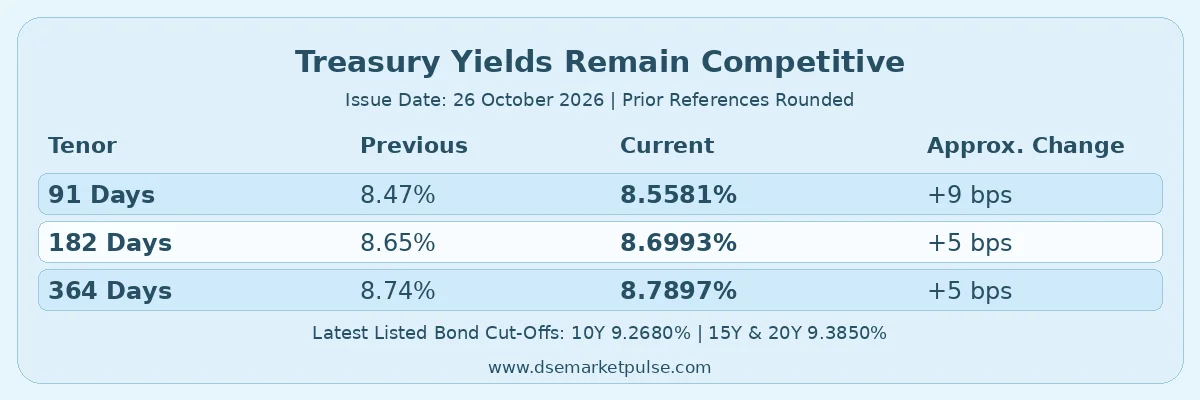
Treasury bill cut-off yields stood at 8.5581% for 91 days, 8.6993% for 182 days and 8.7897% for 364 days in Bangladesh Bank's 26 October issue-date table. These remain above last week's rounded levels of 8.47%, 8.65% and 8.74%. Longer maturities also offer substantial competition: the latest listed 10Y auction cut-off is 9.2680%, while the 15Y and 20Y reissuances each cleared at 9.3850%.
The earlier benefit from falling yields has therefore weakened. Equities now need a clearer earnings and dividend case to compete with government securities, especially when rising costs threaten company margins.
Read More: Bangladesh Bank auction results
External Factors
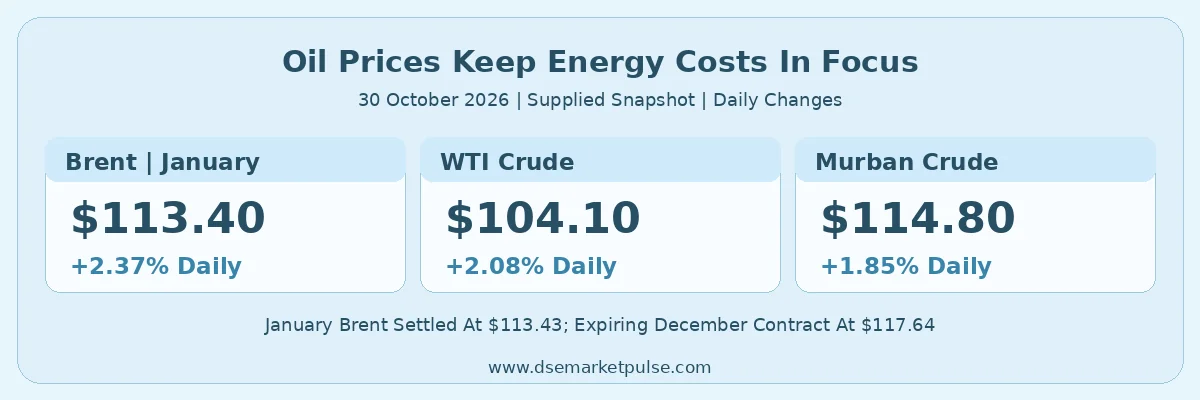
Middle East supply risks remain central to the outlook. Friday Closing shows Brent near $113.40, WTI at $104.10 and Murban at $114.80. Reuters identifies January Brent's settlement at $113.43; the expiring December contract settled at $117.64. The contract difference explains the two Brent figures and should not be read as a sudden price decline.
A tanker attack in Hormuz reinforced supply concerns, while diplomatic efforts continued ahead of the 3 November US midterms. For Bangladesh, the transmission remains higher fuel, freight and insurance costs, with possible pressure on deliveries and business margins. Stable supply routes would offer more meaningful relief than a brief move lower in futures.
Read More: Reuters oil-market report · Read More: Reuters report republished by The Daily Star
Internal Factors
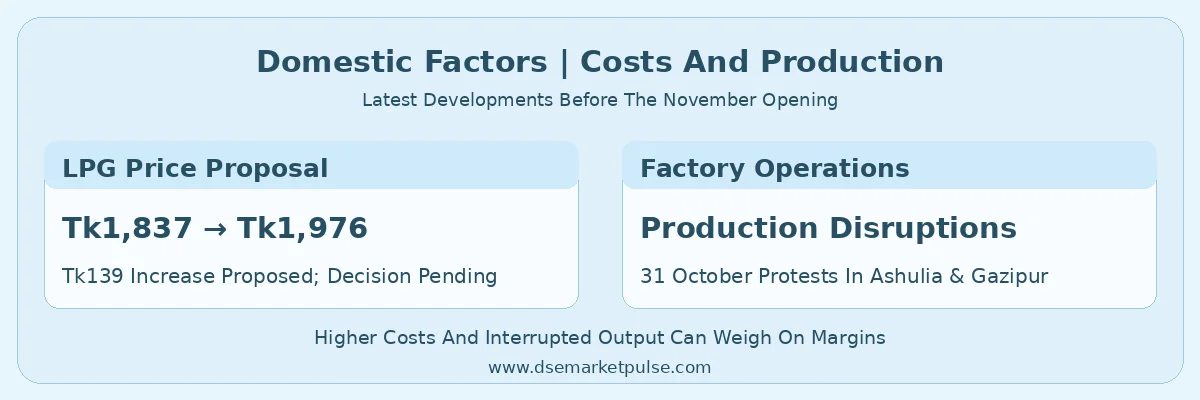
The 29 October LPG hearing brought the cost issue closer to households and businesses. BERC's technical committee proposed raising the 12kg cylinder price from Tk1,837 to Tk1,976, an increase of Tk139. This was a recommendation, awaiting a final decision; BERC invited written submissions through 1 November.
Separately, garment-worker protests disrupted factories in Ashulia and Gazipur on 31 October, adding an operating risk to monitor as the market reopens. If production interruptions persist alongside expensive energy, revenue growth may not translate into stronger margins.
Read More: LPG hearing and proposed increase · Read More: BERC hearing process · Read More: Factory disruptions reported on 31 October
Regulatory Affairs & PSI
BSEC consulted stakeholders on possible amendments to the Mutual Fund Rules, 2025, according to its 29 October release. The discussion emphasised investor protection and institutional participation. It is a reform process to follow, rather than evidence that new rules or fresh institutional buying are already in place.
With October declarations now being absorbed, November's focus shifts from anticipation to assessment. Earnings, operating cash flow, asset quality and dividend sustainability matter more than the announcement headline alone. Last week's bank-leadership theme still needs broader price and turnover confirmation; results should be judged company by company.
Read More: BSEC consultation update · Read More: BSEC press releases · Read More: DSE disclosures
Technical Analysis
The weekly high of 5,477.5 and low of 5,378.9 show that the attempted recovery again met selling. The close at 5,417.4 sits below the 0.618 Fibonacci level near 5,429.2 on the updated chart. The second chart also places the index close to a rising support line, making the next reaction around support important.
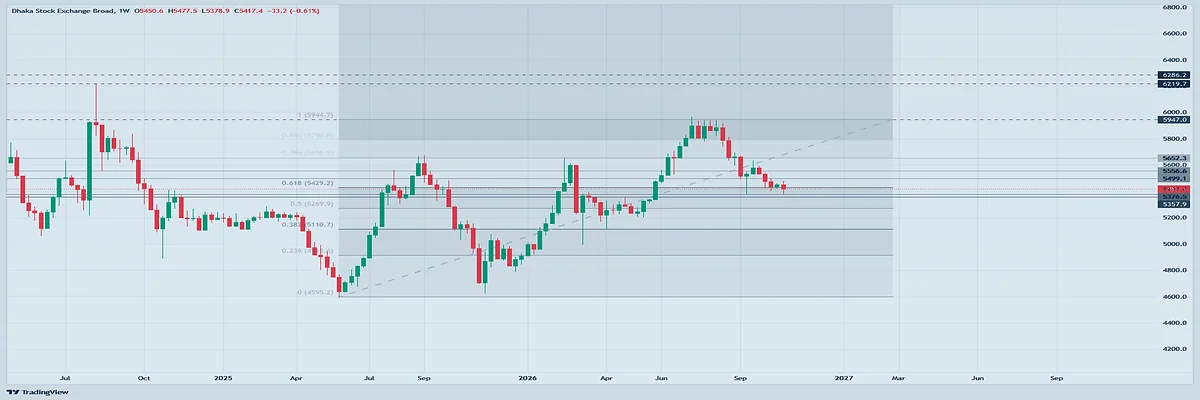
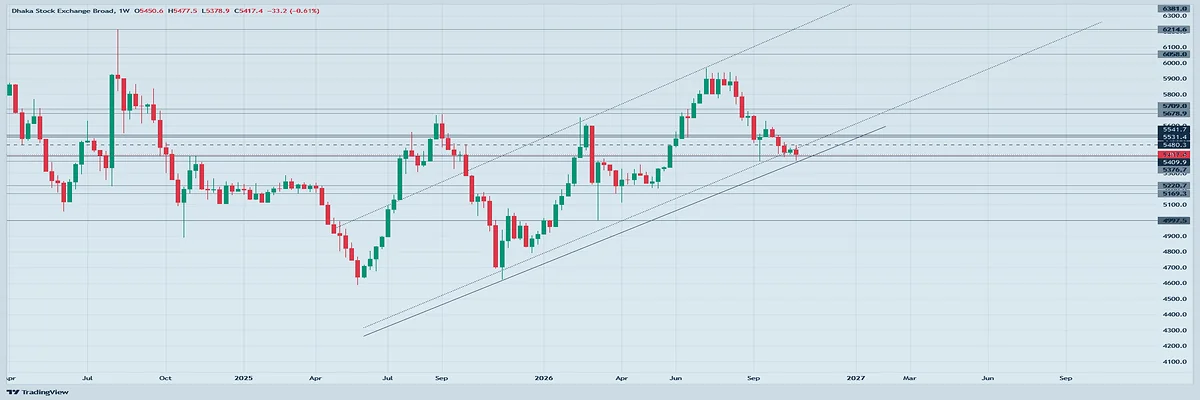
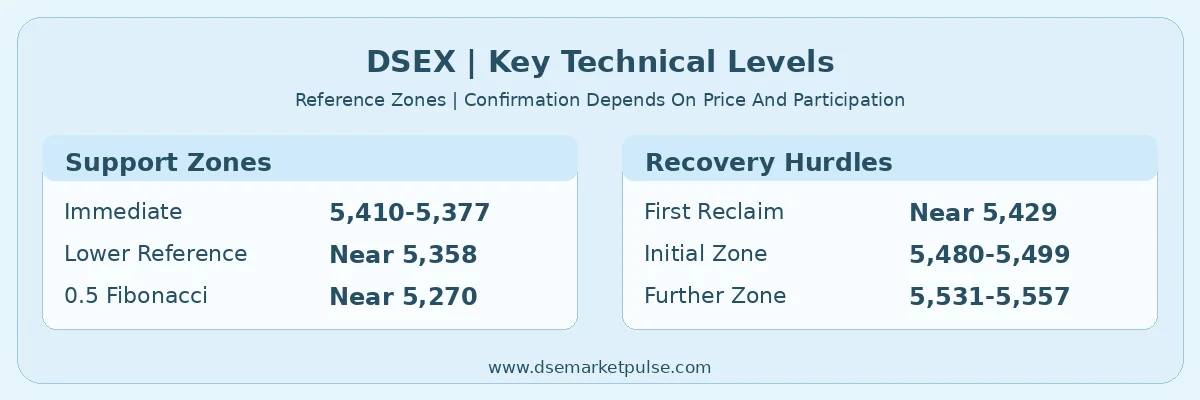
The immediate support area is 5,410-5,377, followed by the lower horizontal reference near 5,358. A sustained break below that band would weaken the base-building attempt and bring the 0.5 Fibonacci region near 5,270 into focus.
On a rebound, reclaiming 5,429 is the first step. The stronger recovery hurdle is 5,480-5,499, followed by 5,531-5,557. Holding support alone does not confirm a reversal; a move through resistance needs better participation and follow-through.
Investor Focus
- Support First: Watch the response around 5,410-5,377 and 5,358 before treating the decline as a completed correction.
- Recovery Confirmation: Track 5,429, then 5,480-5,499, alongside turnover and the breadth of advancing shares.
- PSI Quality: Compare declarations with expectations already priced in, with particular attention to cash flow, provisions and dividend capacity.
- Energy & Operations: Follow Middle East shipping, the pending LPG decision and whether factory disruptions continue.
- November Participation: Higher turnover is encouraging, but a durable recovery needs wider participation beyond a few active shares.







Leave a comment
Please login to leave a comment or reply.